
Inside the Ribadu–El-Rufai Wiretap Case Testing Nigeria’s Rule of Law
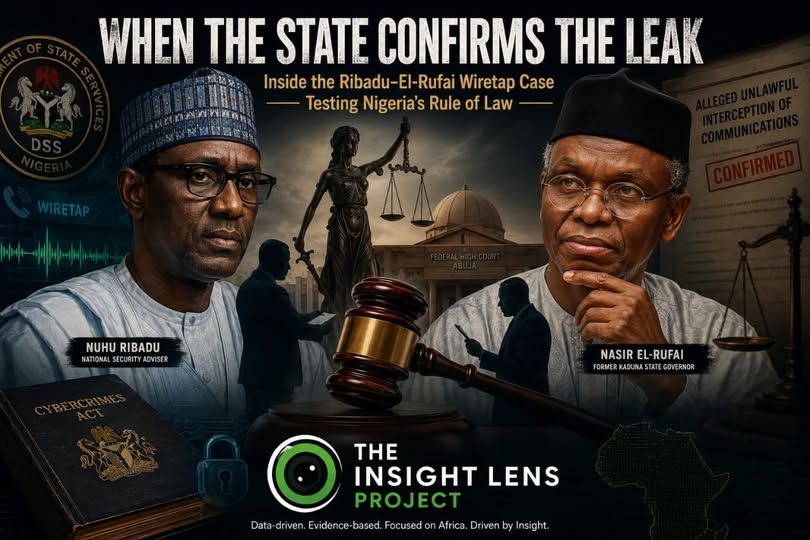
When the State Confirms the Leak – Inside the Ribadu–El-Rufai Wiretap Case Testing Nigeria’s Rule of Law
Nigeria’s political and security establishment has been thrust into another defining moment following dramatic courtroom revelations in the ongoing prosecution of former Kaduna State governor Nasir El-Rufai over alleged unlawful interception of communications linked to National Security Adviser Nuhu Ribadu.
What began as a case framed around national security and cybercrime has rapidly evolved into a wider national debate about selective justice, political power, institutional integrity, and the future of Nigeria’s democracy ahead of the 2027 political cycle.
At the centre of the controversy is testimony reportedly given in court by a witness from the Department of State Services, who stated that Ribadu confirmed the authenticity of the phone conversation publicly referenced by El-Rufai. The distinction is important. Ribadu himself did not publicly acknowledge the conversation in media appearances, rather, according to the testimony, investigators were told during the probe that the conversation was genuine. Even as second-hand evidence, the implication is politically explosive because it appears to reinforce the factual basis of El-Rufai’s controversial public claims.
The contradiction confronting the Federal Government is difficult to ignore. Prosecutors accuse El-Rufai of unlawfully intercepting sensitive communications involving the NSA, yet their own witness reportedly affirmed that the conversation in question actually took place. In effect, the state appears to be arguing that the discussion was real, the alleged detention-related remarks occurred, but the more serious offence was making the matter public. That argument may satisfy a narrow interpretation of the law under the Cybercrimes Act, but politically and morally, it raises questions the government has yet to convincingly answer.
The matter has therefore moved beyond a straightforward criminal prosecution into a broader conversation about accountability and the use of state power. If the conversation indeed involved discussions about detaining a political figure outside established legal procedures, many Nigerians are now asking why the alleged substance of the discussion is not receiving equal scrutiny. Critics argue that prosecuting the disclosure while avoiding a full examination of the content creates the appearance of selective enforcement, a criticism frequently directed at successive Nigerian administrations regardless of party affiliation.
For Ribadu, the implications are both serious and delicate. As National Security Adviser, his office sits at the centre of Nigeria’s intelligence and security coordination structure. Any suggestion that sensitive communications involving the NSA could be intercepted, leaked, or circulated publicly raises concerns about vulnerabilities within the country’s security architecture. At the same time, the controversy risks dragging Ribadu deeper into partisan political conflict at a period when Nigeria continues to grapple with terrorism, banditry, kidnapping, cybercrime, and widespread insecurity across multiple regions.
The developments have also strengthened El-Rufai’s political narrative. The former Kaduna governor has increasingly positioned himself as a sharp critic of the administration of President Bola Ahmed Tinubu and as an influential voice within emerging opposition realignments ahead of 2027. His supporters now argue that the courtroom testimony validates his central claim that the alleged conversation was genuine. Allies of the former governor portray the prosecution as politically motivated, while critics insist that his own televised comments about obtaining intercepted communications provided prosecutors with a legitimate legal basis for the charges.
Legally, however, El-Rufai’s challenges remain substantial. Confirmation that the conversation occurred does not automatically absolve him of potential wrongdoing under Nigerian law. Prosecutors continue to maintain that unlawfully obtaining, sharing, or disseminating intercepted communications may violate provisions of the Cybercrimes Act and other national security statutes. The central legal question before the court is therefore not merely whether the conversation happened, but how the information was obtained, who intercepted it, and whether any laws were breached in the process.
Beyond the personalities involved, the affair exposes deeper institutional weaknesses within the Nigerian state. The case highlights how security agencies increasingly find themselves entangled in political disputes, fuelling public suspicion about whether intelligence institutions are functioning as neutral protectors of the republic or as instruments within elite power struggles. It also revives longstanding concerns about the absence of robust legal protections for whistleblowing and public-interest disclosures in Nigeria’s legal framework, especially when allegations involve powerful state actors.
The political consequences may extend far beyond the courtroom. Every hearing is now unfolding against the backdrop of mounting political tension ahead of the 2027 elections. Opposition figures are likely to present the case as evidence of alleged executive intolerance, while government supporters insist that the state cannot ignore admissions relating to illegal surveillance or the interception of official communications. The danger is that a matter requiring careful legal scrutiny could deteriorate further into another bitter episode in Nigeria’s already divided political culture.
In the end, the Ribadu–El-Rufai saga is no longer simply about an intercepted phone call. It has become a test of whether Nigeria’s institutions can enforce the law consistently without appearing driven by political calculations. The Federal High Court now carries a heavy responsibility, not only to determine whether any laws were broken, but also to reassure Nigerians that justice is neither selective nor politically convenient. In a democracy already struggling with declining public trust, rising political tension, and persistent insecurity, the credibility of the process may ultimately matter as much as the final verdict itself.
Adebamiwa Olugbenga Michael is a Lagos-based journalist, political economy and policy analyst, and publisher of The Insight Lens Project, delivering data-driven open-source intelligence insights on Nigeria, Africa, and global affairs.