ISRAEL BUILT A ROBOTIC BORDER GUARD
ISRAEL BUILT A ROBOTIC BORDER GUARD
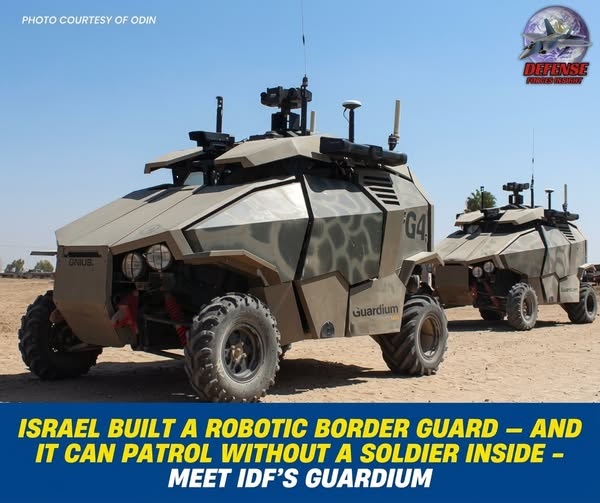
ISRAEL BUILT A ROBOTIC BORDER GUARD — AND It CAN PATROL WITHOUT A SOLDIER INSIDE – MEET IDF’S GUARDIUM
No driver. No crew riding in the vehicle. Just sensors, cameras and an autonomous system moving along the border.
Meet Guardium, an Israeli unmanned ground vehicle (UGV) developed for one of the most dangerous and repetitive missions in modern warfare:
border security.
Instead of sending soldiers to repeatedly patrol exposed areas, Guardium was designed to take on surveillance and security tasks while human operators monitor the mission remotely.
THE VEHICLE THAT CAN PATROL ON ITS OWN
Guardium was developed by G-NIUS, a joint venture associated with Israel Aerospace Industries (IAI) and Elbit Systems.
Built around a rugged Tomcar-based chassis, the vehicle combines off-road mobility with cameras, thermal sensors, communications equipment and autonomous navigation.
It can operate in two basic ways:
Autonomous mode — following programmed patrol routes and responding to detected situations according to predefined rules.
Tele-operated mode — controlled remotely by personnel at a command center.
That means the human doesn’t necessarily have to be physically sitting where the danger is.
ITS BIGGEST WEAPON IS INFORMATION
Guardium can be equipped with a collection of sensors designed to provide persistent surveillance.
Its systems can include:
- 360-degree optical cameras
- Thermal imaging
- Target detection and video tracking
- High-sensitivity microphones
- Two-way communications
- Loudspeakers for warnings
- Laser-warning and hostile-fire indicators
- Missile-approach warning systems
Specialized configurations can also incorporate equipment such as ground-penetrating radar, chemical detection systems and electronic countermeasures, depending on the mission.
The idea is simple:
Detect first.
Investigate remotely.
Send soldiers only when necessary.
AND GUARDIUM IS BUILT FOR SPEED.
The platform can reportedly reach speeds of around 80 km/h (50 mph) and carry a modular payload of up to roughly 300 kilograms.
Its relatively compact size and off-road design allow it to operate across terrain where conventional patrol vehicles may be less practical.
But its real value isn’t simply how fast it can move.
It’s the ability to maintain surveillance without putting a driver at immediate risk.
THIS IS WHERE THE TECHNOLOGY BECOMES INTERESTING.
If Guardium detects an unusual activity or possible border breach, the vehicle can potentially leave its normal patrol pattern and investigate according to its programmed mission rules.
That creates a different model of border security.
Instead of:
Soldier → patrol → investigate → return → repeat
the concept becomes:
Robot patrols → sensors detect → operators assess → human forces respond when required.
That can reduce exposure to routine threats while also helping preserve manpower.
AND THE PLATFORM CAN BE ARMED—BUT THAT IS NOT ITS PRIMARY ROLE.
Guardium has generally been associated with reconnaissance, surveillance and border security, including unarmed patrol configurations.
However, the platform can be adapted for remotely operated weapon systems.
Depending on configuration, this can include non-lethal equipment or a 7.62mm machine gun operated remotely.
That distinction matters.
Guardium’s core concept isn’t to create a fully independent killing machine.
It is to create an unmanned security platform capable of sensing, communicating, patrolling and supporting human decision-making.
THE GUARDIUM FAMILY GOES BEYOND ONE VEHICLE
The concept has also been developed into different configurations.
Some variants are intended for logistics and support, while other unmanned ground platforms have explored more heavily equipped combat roles.
That points toward a broader trend in modern militaries:
Unmanned vehicles aren’t necessarily replacing soldiers.
They are increasingly being designed to perform the missions that expose soldiers to unnecessary danger.
Border patrols.
Reconnaissance.
Logistics.
Route surveillance.
Threat detection.
And potentially, combat support.
THAT MAY BE THE REAL LESSON OF GUARDIUM.
The future battlefield may not be filled only with larger tanks, faster fighter jets and more powerful missiles.
It could also contain small autonomous machines constantly watching the battlefield—quietly moving ahead of human forces.
Israel’s Guardium is one of the earlier examples of that idea being applied to real-world security missions.
And as AI, autonomous navigation, drones and unmanned ground vehicles continue to improve, the question is becoming harder to ignore:
How many dangerous patrols will tomorrow’s soldiers no longer have to perform themselves?
Would you trust an autonomous UGV like Guardium to patrol a dangerous border—or should a human always remain physically inside the vehicle?